


The Watercolour Painting System (previously titled Essential Watercolor) was far from the first online watercolour course I’d taken — but it absolutely should have been. Because it wasn’t, I spent hours frustrated, producing disappointing paintings. Again and again, I heard instructors say things like, “It just takes practice — you’ll get used to it,” especially when referring to tricky concepts like controlling moisture or blending colours. No offence to those instructors, but many seemed unable to clearly explain or demonstrate the subtleties of the medium.
Broderick Wong does.
Broderick Wong, an artist based in British Columbia, Canada, originally earned a Marketing degree from De La Salle University in Manila. Unsatisfied with his corporate path, he left his job to pursue art. Though primarily self-taught (with a few online courses under his belt), you’d never guess it. His command of watercolour and depth of knowledge are outstanding. His courses are offered through his website: www.colorwithwater.com.
The Watercolour Painting System is a self-paced course made up of eleven instructional modules. Each module breaks down the techniques required to create smooth, even washes, and includes three projects and a bonus activity at the end. I’d describe this as a technique-driven course, with a strong emphasis on understanding water-to-pigment ratios for consistent colour depth, as well as the use of washes, glazes, and colour control.
For the number of modules and the depth of instruction provided, this course is very reasonably priced. It’s clear that Broderick put immense thought and effort into making the content accessible, comprehensive, and approachable — all while offering excellent value.
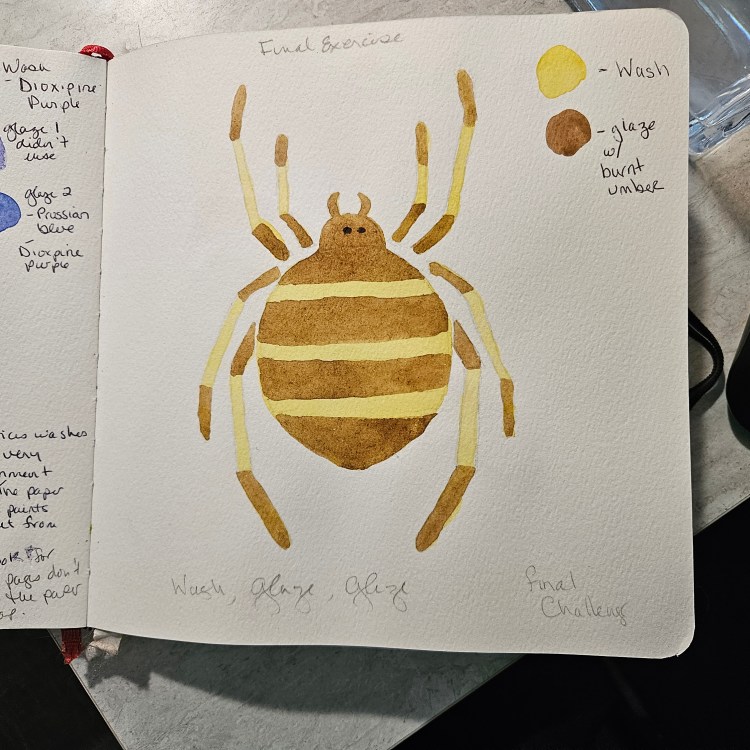
I was initially sceptical. The projects seemed more illustrative than painterly — more like children’s book art than fine art. But having now completed the course, I happily admit I was wrong. Each exercise is perfectly aligned with the learning goals, and they build progressively in difficulty (which I appreciated — I get bored when things are too easy). By the time I reached the final project — a spider painting you can see below — I felt confident I could complete it without needing step-by-step guidance.
There were many “lightbulb” moments for me throughout the course. The most significant was learning about the “bead” — how to keep it alive to maintain a smooth wash. Broderick returns to key concepts like this, as well as the importance of a tonal chart, throughout the course to reinforce their role in successful painting.
One standout feature of this course is its exceptional video quality. Broderick uses a high-resolution camera setup that brings the viewer right to paper-level, offering an immersive and intimate view of the painting process. His use of reflective light makes it surprisingly easy to see subtle shifts in paper wetness — something that’s typically very difficult to capture on film. This made it much clearer when a surface was too dry, too wet, or when a bead was too large or too small — insights that are often missed in lesser-quality video tutorials.
His teaching style is friendly, encouraging, and grounded in practical advice. I emailed him at one point to ask about the course changes, and his reply was just as warm and helpful as his video presence. He’s open about his own mistakes, and when he makes one on camera, he explains how to fix it — modelling a thoughtful, problem-solving approach. He also points out where beginners are likely to struggle and offers specific strategies to address those areas. This course is not just informative — it’s methodical, accessible, and well thought out.
The course does require specific brush sizes and watercolour paints, but you don’t need professional-grade supplies to get started. That said, I do regret not investing in better paper. I used a watercolour sketchbook to track my progress, but its quality was poor: it bubbled, peeled, and had an uneven surface. While it was adequate for early experiments, I was disappointed with how some of my final projects turned out due to the paper alone.
As I mentioned earlier, this wasn’t my first watercolour course — but it’s the one that finally helped me make sense of the medium. I may not be a professional artist, but even as a hobbyist, I want to understand the tools and avoid creating “mud.” Broderick’s course helped me get there. I’ve recommended it to other beginners, and I enjoyed it so much that I’ve since taken three more of his courses.
But I’ll save those reviews for future blog posts.
 A Taylor'd Life