

My first foray into painting was with oils—a medium I still love but haven’t touched for years. Back in the pre-Internet days, I was simply looking for a place to learn. So, where did I land? A Bob Ross Instructor course. Yes, that Bob Ross. I enjoyed it, but eventually tired of landscapes—not to mention the raised eyebrows I got from “serious” artists. But don’t knock the Ross! Even now, I still use some of his techniques, despite having moved on to other media.
For about two decades, I treated myself to a full-week art course every summer. That may sound like a long time, but really, it was the only time I painted all year. In total, twenty years of “one-week-a-year” adds up to only about half a year’s worth of painting. Still, it was a fantastic twenty years. If you ever get the chance to play Artist for a week, I highly recommend the Haliburton School of the Arts.
Most summers, I took the same class: Animals in Acrylics with instructor Jay Dampf. (Jay was allergic to oil solvents, hence acrylics.) My friend Pat Kosynski insisted we keep going back to Jay’s class, and I happily agreed. Jay had a wonderfully supportive style—each student could choose what they wanted to paint, and he’d walk around offering individual tips. No forced “class project.” By the end of the week, every student had something unique to show for it.
Jay had a gentle way of teasing those of us who were meticulous. “You detailers,” he’d say, watching us use tiny liner brushes on massive 30×30 canvases. He always encouraged us to loosen up. We never did.
Sadly, Jay has since passed away. Pat can no longer attend the school, and COVID knocked the wind out of my solo travel ambitions. So, I turned to online courses. I remembered Jay’s refrain—“Oh, you detailers”—and decided it was time to finally learn how to loosen up.
Enter: watercolour.
To be honest, I don’t remember which course was my very first, but Scott Swinson’s Watercolour Landscapes for Beginners was definitely among the first few—and it set the bar for all the courses I took after.
Before this, all I knew about watercolour was that it was “hard” and “unforgiving.” That’s what everyone told me. So I approached it with some anxiety but also a lot of curiosity. I started picking up inexpensive online courses here and there, and somewhere along the way, I stumbled upon Scott’s class. What a lucky gamble that turned out to be.
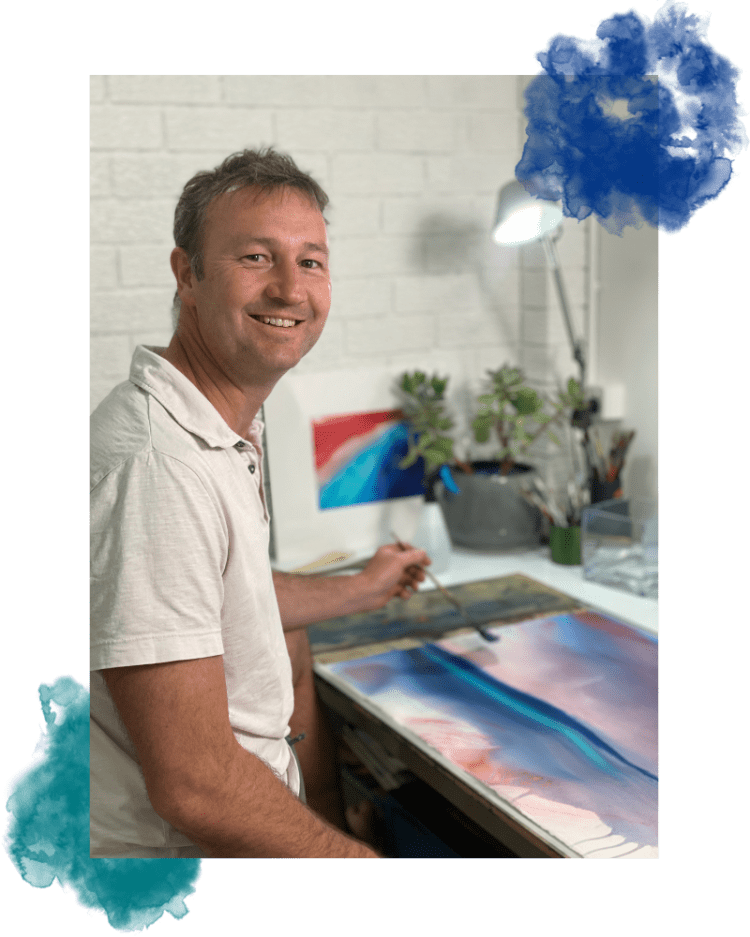
Scott, who hails from Tasmania (yes, I immediately pictured the Looney Tunes character too), has been painting for over 30 years. He studied under the renowned Tony Smibert and spent time learning the techniques of J.M.W. Turner at the Tate in Britain. His teaching style is rooted in both tradition and experimentation.
The course I took—Watercolour Landscapes for Beginners—was hosted on his independent website, www.scottswinsonclasses.com. It includes 15 self-paced modules (plus bonus content), a companion eBook, and access to a private Facebook group full of encouraging fellow students.
Enthusiasm is the word that best describes Scott’s teaching style. He loves watercolour, and that passion is infectious. His approach is loose—just what this recovering detailer needed. It’s not a “paint-by-numbers” course, but it does offer guided projects. And let’s be honest: no one can truly replicate another watercolourist’s painting. But you can learn from the process.
I found the course challenging, mostly because I was still so new to watercolour. But Scott broke things down beautifully—from mixing paint and creating washes to exploring texture techniques (who knew salt could be so useful?). His pacing was spot on. Each lesson built on the last, moving from simple washes to richly atmospheric landscapes.
I finally understood what people meant by “paint consistency,” and that revelatory moment when Scott said in his Australian accent, “You only get one go with a colour—after that, it’s mud,” stuck with me. His lessons on composition were also fantastic—guiding the eye across the painting and softening edges to pull the viewer’s attention inward.
I completed every module—though I admit, I never worked up the nerve to post my paintings in the Facebook group. Still, I gained so much from the course. I learned about charging paint, layering glazes, and creating textures with unexpected tools (like a credit card!). Scott was transparent about his own mistakes on camera, using them as teaching moments—like a stray paint drop or a rogue brush hair landing in the clouds.
The video quality was excellent. When he zoomed in on the mixing tray, you could actually see the texture and thickness of the paint. Materials included artist-grade paint, high-quality cold-pressed cotton paper, and a variety of brushes. I initially used a low-quality paint set I had lying around (a brand so obscure, Google didn’t recognize it). It made everything harder. Once I upgraded my materials, my work noticeably improved—especially after ditching the frustrating sketchbook I mentioned in a previous blog post.
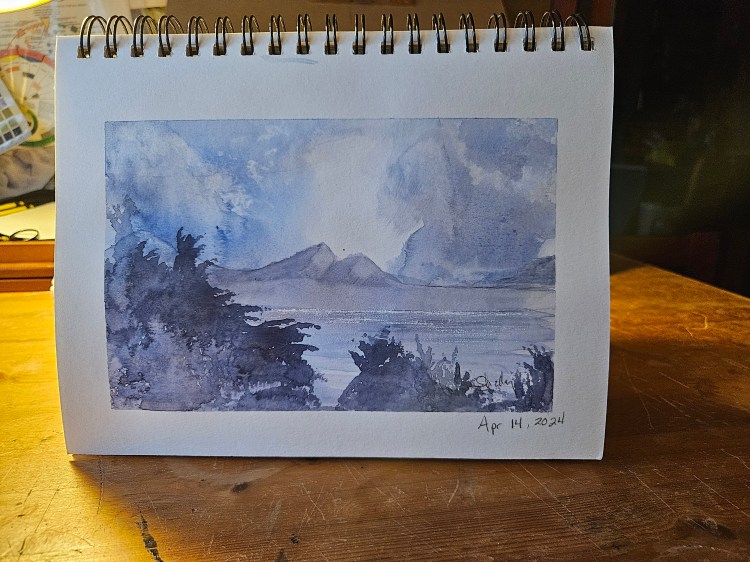
I’ve included one of my early assignments below. For a beginner, I’m quite pleased with it. I still revisit Scott’s classes now and then—to brush up on technique, enjoy his lovely Aussie accent, and smile at the signature hat hanging on the peg behind him.
Will I take another course from Scott? Probably. His teaching style really resonated with me, and his courses are very reasonably priced for the amount of content and quality instruction provided.
 A Taylor'd Life