
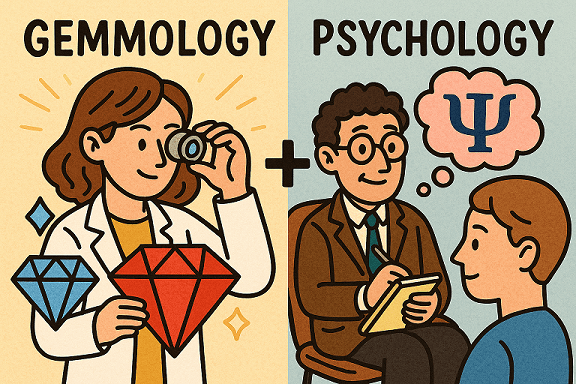
If you had met me in my twenties, you would never have guessed I’d end up as a psychotherapist. At the time, I was far more interested in diamonds than diagnoses, inclusions than intrusive thoughts, and refraction patterns than reframing exercises.
For 15 years, I lived and breathed gemmology.
I even taught at the Gemological Institute of America — an experience that still surprises people who only know the “psychotherapist version” of me. (Yes, I once stood in front of classrooms full of people talking about rubies and emeralds instead of grief and anxiety.)
Looking back, it seems like a wildly strange career jump.
But the older I get, and the more clients I sit with, the more I realise something:
my two careers have far more in common than they have differences.
And in their own odd way, they both shaped me into the therapist I’ve become.
Let me explain.
—
The Gemmologist Who Learned to See What Others Missed
When I started in gemmology, I thought it was about sparkle.
Wrong.
It’s about bone-dry precision and noticing things the human eye was not designed to see.
I spent years looking through microscopes trying to identify:
tiny inclusions the size of a whisper
barely-there colour shifts
minute irregularities that determined value
tricky features that separated natural stones from treated ones
It was attention to detail bordering on obsession.
I didn’t know it at the time, but that skill — paying attention to what’s hidden — would be the single most valuable thing I’d carry into psychotherapy.
Because clients are not unlike gemstones:
most of their real story is beneath the surface.
—
When I Came Back to Canada, My Career Decided to Take the Scenic Route
After California, I returned to Canada and worked in every position imaginable:
computer applications
administrative roles
cellular sales
jobs that had nothing to do with gemstones or therapy
Think of it as a buffet of life experience.
At the time, it felt chaotic.
In hindsight, it taught me more about people than any psychology textbook ever could.
People under stress.
People trying their best.
People losing their temper at customer service reps.
(They should give PhDs for surviving that alone.)
Every job, no matter how random it seemed, sharpened my ability to understand human behaviour.
—
So How Did Gemmology Lead Me to Psychotherapy?
You might think: “Surely there’s no connection between evaluating diamonds and helping people deal with trauma?”
But here’s the twist — they require the exact same skill set.
Gemmology:
“Tell me what’s going on inside this stone and why it looks the way it does.”
Psychotherapy:
“Tell me what’s going on inside you and why you feel the way you do.”
Both require:
observation
patience
curiosity
pattern recognition
comfort with complexity
a trained eye
and the ability to say, “Hmm… that’s interesting. Let’s look closer.”
The subjects just changed:
from sapphires to stories, from inclusions to emotions, from light refraction to life reflection.
And both careers taught me the same truth:
Everything precious has its flaws — and the flaws often make it more interesting.
—
What Psychology Gave Me That Gemmology Couldn’t
Psychology gave me:
the science behind why we feel the way we do
the privilege of sitting with people in their most vulnerable moments
a deeper understanding that everyone — truly everyone — is worth the effort of healing
And oddly enough, after years of staring at gemstones under microscopes, I was already primed for the job.
Gemmology taught me discipline.
Psychology taught me compassion.
Together, they gave me perspective.
—
My Secret Belief: People Are More Like Gemstones Than They Realise
We all have our inclusions — little fractures, cloudy spots, rough edges, or histories that shaped us under pressure.
But we also have brilliance.
Sometimes it just takes the right lighting (or the right conversation) for someone to see it again.
In both careers, my favourite moment has always been the same:
That quiet shift when someone suddenly recognises their own worth.
—
And That’s How a Gemmologist Became a Psychotherapist
It wasn’t a leap.
It was a slow unfolding — like moving from examining the structure of stones to understanding the structure of human experience.
One career taught me how to see deeply.
The other taught me how to help gently.
And in the end, it turns out I didn’t change professions so much as change the subject.
The skill stayed the same:
Help people recognise the value they forgot they had.
 A Taylor'd Life