When I first came across Ian Fennelly’s artwork, I wasn’t entirely sure what to make of it. (https://www.urbansketchcourse.com/)
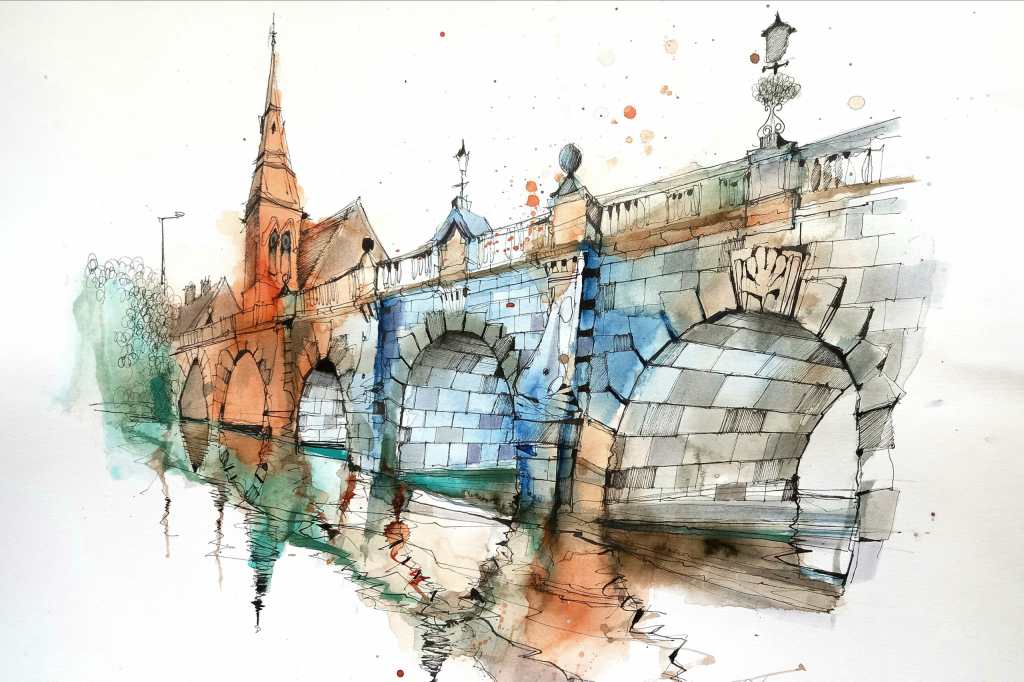
The buildings leaned at improbable angles. Perspective bent and stretched. Ink lines wobbled rather than marched neatly across the page. Colours drifted far beyond where reality said they should be. A stone wall might suddenly bloom with violet, turquoise, or deep blue. At first glance, it almost felt cartoonish — more graphic novel than traditional fine art.
And yet, I couldn’t stop looking at it. There was something undeniably alive about his work.
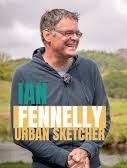
Ian Fennelly is a UK-based urban sketcher and former architectural illustrator whose expressive ink-and-watercolour style has developed a devoted following online. His courses focus on location sketching, loose line work, expressive colour, and capturing the feeling of a place rather than rendering a perfect photographic copy.
That last part turned out to be far more challenging than I expected.
I am, by nature, a detail-oriented person. I like control. Even in art, I tend to tighten things up, refine edges, and focus on precision. Watercolour itself is not my preferred medium, so I already approached the course feeling slightly outside my comfort zone. Ironically, I felt far more confident with the ink work than with the paint.
The very first moment of anxiety came with what should have been the simplest step: placing the first blob of watercolour onto the paper.
Unlike many instructors who carefully pre-mix colours on a palette, Ian often allows colours to mingle and blend directly on the page. Oranges drift into violets. Blues bleed into warm Greys. Shadows dissolve into unexpected cool tones. At first, my brain resisted it. Walls are not violet. Sidewalks are not turquoise. Buildings are not streaked with abstract splashes of colour.
Except, in a strange way, they are.
What Ian’s course gradually taught me is that reality is far less literal — and far more colourful — than I realised.
There is no such thing as a perfectly “brown” wall. Light shifts constantly. Reflections bounce between surfaces. Shadows cool and soften colour. Warm sunlight changes everything it touches. Ian captures these nuances not by rigid realism, but through expressive interpretation. His use of colour is less about copying and more about communicating atmosphere, light, and energy.
What initially looked messy or exaggerated began to feel surprisingly sophisticated.
One of the things I appreciated most about Ian’s teaching style was the intentional looseness behind it. Nothing is ruler-straight. He often holds his pen far back from the nib, encouraging movement and unpredictability in the line work. Buildings taper, curve, and distort slightly, yet somehow still feel believable. There’s an energy to his sketches that makes even old architecture feel animated and alive.
At the same time, the looseness is not careless.
That distinction became increasingly important as I worked through the course. Ian is not simply splashing paint around randomly. Underneath the expressive lines and playful washes is a strong understanding of composition, perspective, value, and visual storytelling. In fact, one of the most surprising parts of taking the course was realising how much artistic judgment hides beneath work that appears spontaneous.
His courses also feel refreshingly human. Ian includes footage of himself sketching on location, interacting with curious passersby, taking rough reference photos, and building compositions back in the studio. Those moments are not edited away, and the result is a teaching style that feels approachable, playful, and genuine.
That said, I do not think this would be my first recommendation for someone completely new to watercolour. Before taking Ian’s course, I had already completed several others and had at least a foundational understanding of how watercolour behaves. Ian does not spend much time discussing colour theory, paint properties, or correcting mistakes. His teaching is more experiential than technical. He shows you how he sees the world and invites you to loosen your grip enough to try seeing it that way too.
And that can be uncomfortable for newbies.
As someone with perfectionistic tendencies, I found myself trying to regain control in other ways. If I could not perfectly control the paint itself, then surely I needed the exact brushes, exact colours, and exact supplies Ian used. In retrospect, I can laugh at that a little now.
Still, despite the anxiety, I genuinely enjoyed the process.
There were moments while painting reflections or allowing colours to merge wet-into-wet where something suddenly clicked. The painting stopped feeling like a technical exercise and started feeling playful. Alive. Even freeing.
One of the biggest shifts for me involved learning to leave things unfinished. In many traditional painting courses, there is an unspoken expectation to fill every inch of the canvas. Ian often does the opposite. Buildings dissolve into white paper. Water reflections trail off into suggestion rather than detail. Entire sections remain implied rather than fully rendered.
I found that incredibly difficult.
And yet, it was also one of the most valuable lessons.
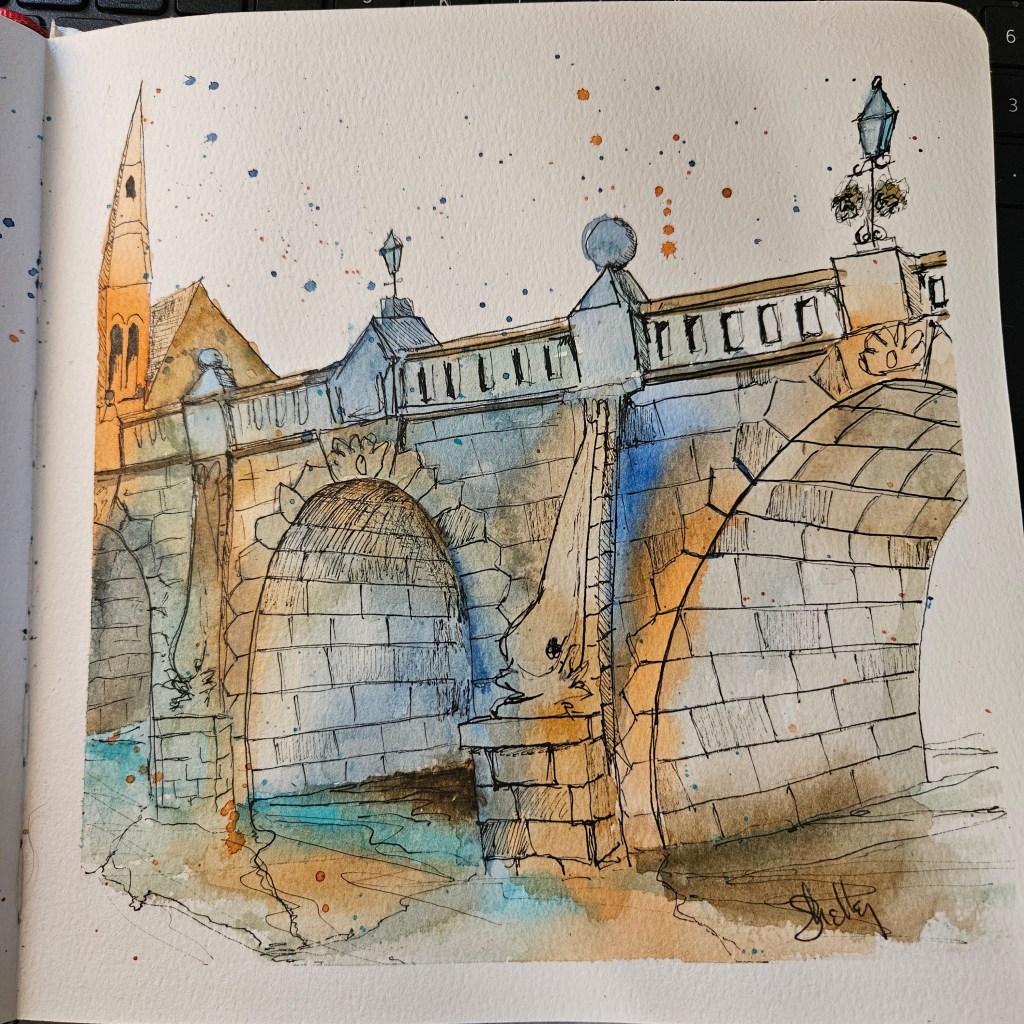
Since taking the course, I have started looking differently at urban spaces, architecture, and even colour itself. I am beginning to appreciate sketching not merely as documentation, but as interpretation. While I still don’t know whether this style will ever become my “final artwork” style, it has absolutely changed how I approach my sketchbook.
It taught me that looseness in art is not the absence of skill.
Sometimes, it is another way of seeing.
 A Taylor'd Life